History of Piano Service Co Ltd. (as known by J B Taylor E&O.E 11/10/1993)
Fredrick Bertie Sheiley started the business about 1947.
He was a cockney, very good salesman and had lived in NZ for quite some time – he served in the Pacific during the war.
Originally the shop was in George Street PN along from the ballroom Astoria – when I joined the firm this was used as a storage base – Bell pianos were stacked 2 high in their crates.
Fred started importing pianos in the early 50’s – mainly Bell, Knight, Cramer etc. He on sold some of these shipments to other dealers throughout the country.
In approx 1954 the shop moved to 80 The Square, and in 1960 expanded to take in 81 as well.
During the T.V. era the firm had the “Bell” agency and sold many TV’s radiograms etc.
The Original vehicle was a Morris Commercial Van (1951) which could carry 3 pianos at once.
I joined the firm as a schoolboy during holidays and after school in 1960. At that time we also had a bedford van with sliding doors and a raised roof.
Fred employed a series of tuners – Charlie Driver, Tony Pennington (ex Broadwood Factory),Len Andrews, Eric Stewart (ex English Factory). I started full time with the firm in 1964. Ray Trownson worked for years in the shop (selling). Fred son, Tony Shelley worked on & Off for the company and finally bought the firm from Fred in 1974.
Fred had the Yamaha agency from about 1963 – imported as “Steigerman” as the Japs weren’t still too popular.
Tony had a number of workers – Ken Schlierike – part timer (old friend of Freds). Murray Harris, Venona Nicols (head hunted from the old original Beggs chain before it went under – Wisemans bought the Beggs chain and then sold it to individual managers (Rob Roy in PN)).
The sheet music side was upstairs above the shop (I did the alterations, etc) until it was moved down into the shop when the rear extension was built by the owners of the building.
By this time the shop frontage had been narrowed to be 81 The Square only and a carpet shop, Mark Twain Restaurant & coffee Bar all at one time moved into the old area.
In 1980 Tony decide to sell the business and move to Australia.
The firm was sold to Pat and Helen Thomas. Pat organised a Yamaha music school at first in the rear of the shop then upstairs teaching electronic organ.
In approx 1988 the rent on the building trebled so Pat moved over next to McDonalds on the other side of the square and I left to work on my own, selling though the shop and using them as an agency – at this time Brian Watt bough into the firm (now known as the Music Center)
I had both there permissions to use the name Piano Services and trade as a sole trader. (Piano Service Co LTD ended).
In 90 -91 I sold the old firms gear, name and goodwill to Allen C Birchler (rest of history follows).
The old string maker was sold in about 1981 to Beggs (Wgt) – it was given to me by Tony when he left – but I didn’t know how to use it!
Both Fred & Tony (&Pat) used Frank Caple (the local blind tuner) for some shop tunings and for “fussy tuning customers” – Frank died 14 Dec 1988.
Fred was a hard case guy – loved his race horses – Piano Service Co Ltd advertised for years every Sat. am and sponsored the race horse scratching. He owned 2 race horses – also loved his trout fishing, long line sea fishing & white-bate. He built a large house at Waiterere overlooking the bowling green but his wife died suddenly so he moved to Taupo, Auckland & bank to Taupo where he ran “Friendly Freds”, a second hand shop before going to Mangakino where he died in 1992.
The Following article was on http://www.stuff.co.nz May 2018 about Jim Taylor.
An old trade that still hits the right notes.
History of E. H. VERNON & Co LTD (as known by A Birchler.)
The first meeting of this company was held on Tuesday 5th April 1949 at 4.30pm. At this meeting it was reported by the company solicitor, Mr T.M.N. Rodgers that the company had been incorporated on 25 March 1949 under number 116. However business didn’t actually commence until 4th April 1949.
Mr Ernest Zuccani Henry Vernon and Mr Gordon Mervyn John Currie were share holders. Later that year Mr Gorge Richard Green became a share holder and the 3 became directors of the company. In 1949 Three Hundred Pound was borrowed from the State Advances Corporation of New Zealand to buy a Hillman Truck, this was personally guaranteed by Mr Green.
In October 1949 Mr Vernon resigned from been Managing Director and Mr Currie was put in place, by the end of 1949 Currie and Green requested that Vernon resign as a director. This is the last mention of EH Vernon in the Minutes Books.
In 1981 Green resigned and Leonce C P Jones was appointed Director (Curries son-in-law). In 1993 Currie died and the Company was purchased by Allen C Birchler in July that year.
With this change over, EH Vernon & Co Ltd bought Piano Services from Allen C Birchler and then the company started trading as Piano Services (EH Vernon & Co Ltd).
The previous living directors have been asked to help with some company history but so far have not been forthcoming. They saw myself as an un-welcomed competitor and the take over was not in their business plan! “VENI VEDI VECI”
G Currie was known around this area for his dance band, many people still ask about him. The area he serviced was the general PN districts.
History of both PIANO SERVICES and EH VERNON & Co Ltd since Birchler ownership.
After working as an independent tuner for about 8 years in Palmerston North Allen C Birchler bought Piano Services from JB Taylor in 1990. The purchase of Piano Services came about because unusual trading practices at the time …..There was a person tuning pianos in the area who was doing cash work, not paying the correct tax and also collecting the unemployment benefit, AC Birchler felt that was not fair so he placed an advertisement with the Social Welfare Dept. for a piano tuner to work for him (if there was an unemployed piano tuner on their books the Social Welfare would subsidize the wages). This lead to the tuner not wanting to work for AC Birchler because it would mean that his business would have to close shop – this resulted in the Social Welfare pulling the plug on the dole money. However JB Taylor was friends with the tuner and he found out about the job vacancy (which was really on offer to stop the competition doing under hand deals and claiming the dole) and applied, this lead to him selling the business to AC Birchler.
The Piano Services shop then moved to 198 Rangitikei Street where it traded until the fast food chain (Georgie Pie) bought it out of the lease, then it moved to 16 Bennett Street for 3 years before moving back to 278 Rangitikei Street, in 2001 Piano Services move to 190 Featherston Street Palmerston North with both the workshop and the showroom.
EH Vernon & Co Ltd was purchased from Currie in 1993, all the stock and plant was moved to 198 Rangitikei Street and in 1993 EH Vernon bought Piano Services from AC Birchler, now the name EH Vernon & Co Ltd is trading Piano Services. This resulted in the two piano tuning company’s ending up under the one roof. All the tuning and repair work is now undertaken by AC Birchler.
A Brief History of Piano Insulators
Firstly, what is a piano insulator? Well, today we’d probably be more familiar with the term castor cup or coaster… the small bowl-shaped pieces of wood or plastic that sit under the piano’s legs preventing damage to the floor. But in Victorian times they were a far more elaborate object, and often considered to be an important part of the piano.
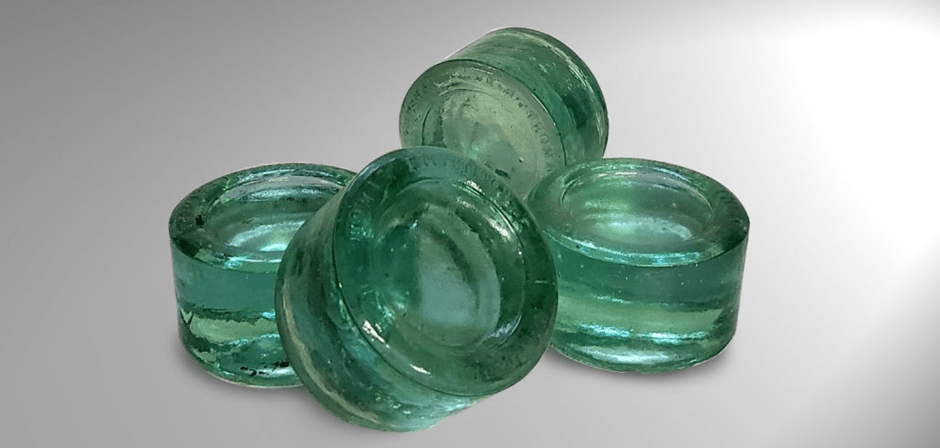
Four Kidsgrove piano insulators from the 1860s. Photo: Ellis Willis & Beckett Auctioneers
The term “piano insulator” first started appearing in newspaper adverts around 1850. One such advertisement read (albeit somewhat clumsily by today’s standards) …
BARLOW’S PIANOFORTE INSULATORS – A new invention, important to those who value quality of tone; by which inferior and weak-tone instruments are surprisingly improved in tone, whilst to those of first-rate makers they are applied with great advantage, as they are the means of obtaining a perfect vibration, a delicious sweetness of tone, with such increased power and brilliancy as are truly admirable, which can never be obtained from a piano standing on a carpeted floor, the deadening effect of which cannot be successfully overcome without them. Price 6s. the set.
James Barlow, inventor and manufacturer, 14, King William Street, Mansion House.
The product advertised was a set of small circular press-moulded glass cups on which the piano would stand. Curiously, here the product’s key selling point was it improved the quality of the piano’s sound. This doesn’t really relate to the “piano insulator” moniker.
This term suggests that the piano’s sound is insulated from the floor, preventing it from travelling to adjoining rooms/properties. Does this really sit with the idea of improving the tone? In fact, these glass accessories enhance the transmission of vibrations through to the floor, and this would possibly enhance the piano’s sound.

A typical late-Victorian piano insulator
The popularity of piano insulators increased rapidly throughout the latter part of the 19th century. So much so that some retailers would give away a set with each new piano sold. At the same time, the product’s design became increasingly more elaborate and decorative.
One English manufacturer (John Derbyshire and Co.) produced a range of insulators in the shape of animals’ feet. These are now highly sort after.
Pressed Glass
Pressed glass piano insulators were produced in many different colours. Green was probably the most popular, but amber, blue, yellow, and clear glass examples were quite common.
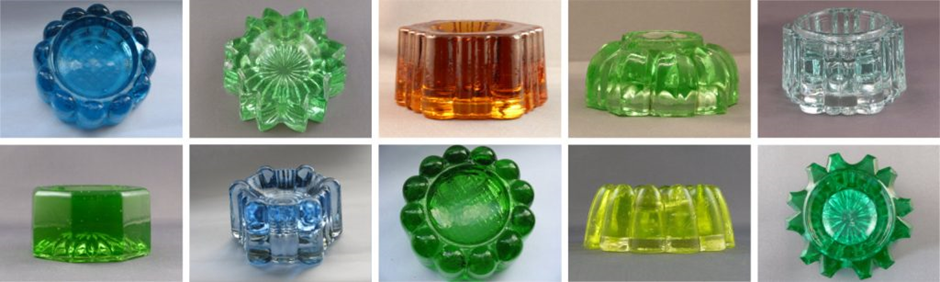
A selection of glass piano insulators. Photos: Christine Hudson
Pressed glass, sometimes called pattern glass, was developed in the United States around the 1820s. It was first patented by John P Bakewell. It simply involved taking a measure of molten glass and forcing it into a pre-heated metal mould using a lever/plunger mechanism.
Piano insulators seemed to be most popular in the UK and Germany. But in 1901 American John Brissel introduced a bronze and metal insulator with a rubber base. This design again claimed to both increase volume and tone whilst preventing the sound from penetrating the floor.
The piano insulator did have other advantages. It helped prevent damage to the floor, be it wooden or carpeted. It also stopped damp rising up the piano’s legs and damaging the instrument — a different type of insulation?
Collectors’ Items
Glass piano insulators with their intricate designs have become highly collectable over recent years — more amongst the glassware enthusiasts than the musical instrument fraternity.
Piano castor cups are still produced and widely used, primarily to protect floors and carpets. Most are either made of hardwood, brass, or plastic, often with a rubber base, but you can still get ones made of glass. Manufacturers, however, no longer claim that these items improve sound quality!
Acknowledgements: I am no great expert in this subject and would like to thank Lindsey who runs the Heart of Glass website for her help in preparing this piece. Do take a look at her article on “Piano Insulators” for a fascinating and far more detailed exploration of the subject. And also go to Christine Hudson’s website lustrousstone.co.uk to see more beautiful piano insulator designs.
 pianoservices.co.nz